
Fingerprint Launches Fraud Score, Helping Customers Catch Up to 50% More Fraud With Models Trained on Their Own Data
Combines proprietary device intelligence with each customer’s fraud data to deliver more accurate predictions tuned for

Press Release Disclaimer: This is a press release distributed through the XPR Media network. It has not been independently verified by our newsroom.


Fingerprint, the industry leader in device intelligence, today launched Fraud Score, a predictive fraud signal trained directly on customers’ own fraud outcomes and powered by Fingerprint’s industry-leading device intelligence and machine learning models. Fraud Score learns the fraud types at each organization to help them identify fraud more accurately without having to build and maintain their own models.
This press release features multimedia. View the full release here: https://www.businesswire.com/news/home/20261110815855/en/
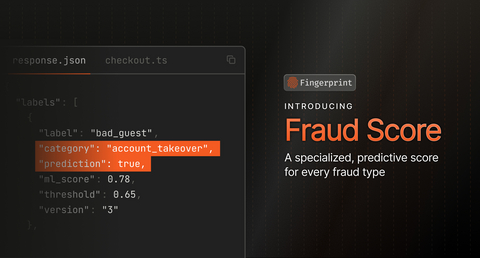
Basic risk scoring can’t match the many types of fraud
“Businesses today face a wider range of fraud threats, amplified by AI-powered techniques,” said Suzanne Sando, Lead Analyst at Javelin Strategy & Research. “Those threats vary by organization and attack type, but one thing is clear: static, one-size-fits-all risk scoring is no longer enough.”
As online fraud becomes more sophisticated, security and risk teams struggle with translating more signals than ever before into accurate, actionable decisions. Despite these complexities, most tools treat fraud as a monolithic problem. However, account takeover (ATO), payment fraud, promotion abuse and fake account creation each exhibit distinct behavior, requiring distinct detection strategies. Generic risk scores fail to capture these nuances, forcing engineering and fraud teams to spend countless hours on manual analysis, complex rule-building and ongoing model maintenance.
“Fraud teams have a signal-to-decision problem,” said Catherine Woneis, VP of Product at Fingerprint. “We built Fraud Score to give every organization the power of custom machine learning without the complexity of building and maintaining custom models. Fraud Score trains specialized models on each customer’s actual fraud outcomes and our device intelligence, enabling teams to stop specific threats with far greater precision.”
Transforming raw device signals into informed business decisions
Fraud Score eliminates complexity and uncertainty for risk teams by delivering turnkey, customer-tailored modeling. In a head-to-head evaluation, Fraud Score caught nearly 50% more fraud than one customer’s existing in-house model, with no increase in good users blocked.
Fraud Score pairs Fingerprint’s broad set of device intelligence signals with fraud outcomes provided by each organization to build and maintain specialized models tailored to each organization’s unique traffic. Fraud teams can act on Fraud Score’s specialized predictions directly or integrate them into their existing decisioning systems via Fingerprint’s API responses. As customers provide new outcomes, Fingerprint continuously retrains the Fraud Score models.
Unlike alternatives that rely on generalized network rules or require internal data science teams to maintain their own prediction layers, Fraud Score is:
- Specialized by Fraud Type: Optimizes separate models and predictions for distinct threat vectors, including payment fraud, ATO, multi-accounting, fake account creation, promotion abuse, platform abuse, content abuse and more
- Trained on Customer Data: Learns directly from an organization’s fraud outcomes, ensuring predictions reflect their specific users and traffic patterns
- Powered by Device Intelligence: Ingests Fingerprint’s device intelligence signals, uncovering correlations and anomalies that manual rules miss
“Simply blocking the visitor ID wasn’t enough to stop our savvier fraudsters,” said David Fennessey, Principal Software Engineer at Flink. “With Fraud Score, we can partner with Fingerprint to collaborate on a model based on our own internal fraud analysis and stop future abuse before the order is placed.”
Fraud Score is available starting today.
About Fingerprint
Fingerprint detects the intent of human and agentic visitors. Our device intelligence platform identifies over 1 billion unique devices every month and processes hundreds of signals to help fraud teams distinguish trusted visitors from bad actors at speed and scale. Over 6,000 companies, including innovators like Plaid, Booking.com, Dropbox, Trustpilot and Checkout.com, use Fingerprint every day to recognize high-risk activity in real time, prevent fraud attacks and deliver frictionless user experiences. Learn more at fingerprint.com.
Frequently Asked Questions (FAQ)
What is Fingerprint’s Fraud Score?
Fraud Score is a predictive fraud signal powered by Fingerprint’s foundational device intelligence and custom machine learning models. Fingerprint trains Fraud Score directly on a customer’s own fraud outcomes to generate accurate fraud predictions that each customer can use directly or incorporate into its existing risk decision systems.
Why is traditional risk scoring inadequate?
Fraud teams have access to more telemetry than ever, but turning raw signals into accurate decisions requires detailed manual analysis and constant rule maintenance. Additionally, different types of fraud behave differently: an ATO looks very different from promotion abuse, for example. One-size-fits-all risk scores lack the context of a specific business’ traffic and the nuance required to separate distinct fraud types.
Which specific types of fraud does Fraud Score address?
Fraud Score makes predictions for specific types of fraud, including payment fraud, ATO, multi-accounting, fake account creation, promotion abuse, platform abuse and content abuse.
How does Fraud Score perform compared to previous methods?
In a head-to-head evaluation, Fraud Score caught nearly 50% more fraud than one Fingerprint customer’s existing in-house model, with no increase in good users blocked. Most competing tools either offer static, black-box risk scores based on generalized rules or require the customer’s internal data science team to build, train and maintain the prediction layer themselves. Fraud Score delivers customer-specific modeling, pairs it with a broader set of underlying Fingerprint device intelligence signals and handles model training and retraining.
How is Fraud Score implemented and maintained?
Customers provide their fraud outcomes via Fingerprint’s dashboard, API or S3, where they can also manage labels and analyze model performance. Once trained, Fraud Score returns predictions directly via Fingerprint’s API. As customers provide new fraud outcomes, Fingerprint retrains the models to stay ahead of shifting fraud tactics.
View source version on businesswire.com: https://www.businesswire.com/news/home/20261110815855/en/
Media gallery


