More drivers are staying in their current cars. Why they should consider revisiting their original loan.
Caribou reports that rising car prices are leading more Americans to keep their vehicles longer, yet many haven't

Press Release Disclaimer: This is a press release distributed through the XPR Media network. It has not been independently verified by our newsroom.


Iaroslavv // Shutterstock
More drivers are staying in their current cars. Why they should consider revisiting their original loan.
With new car prices averaging $50,000 and inflation squeezing household budgets, more Americans are holding on to their car for longer. Findings from Caribou’s 2026 Car Loan Sentiment Survey of 2,000 U.S. auto loan holders suggest that this decision to stay put raises the financial stakes on loans most borrowers have never revisited. Only 29% of borrowers have ever checked whether they qualify for a lower rate, yet 85% agree that saving $150 a month on their car loan would make life significantly easier. Caribou broke down why drivers should revisit their original auto loan.
High car prices compel drivers to stay put
The average vehicle on U.S. roads today is approximately 13 years old, a record high according to Bureau of Transportation Statistics data. This is up from nearly 10 years in 2006.
Caribou’s survey data tracks closely with what the broader auto market shows. Nearly two-thirds (65%) of auto loan holders say they’ve noticed new car prices rise over the past year. Among that group, the single most common response—by a wide margin—is to keep their current vehicle longer, cited by 41%. Buying a used car instead came in second at 17%.
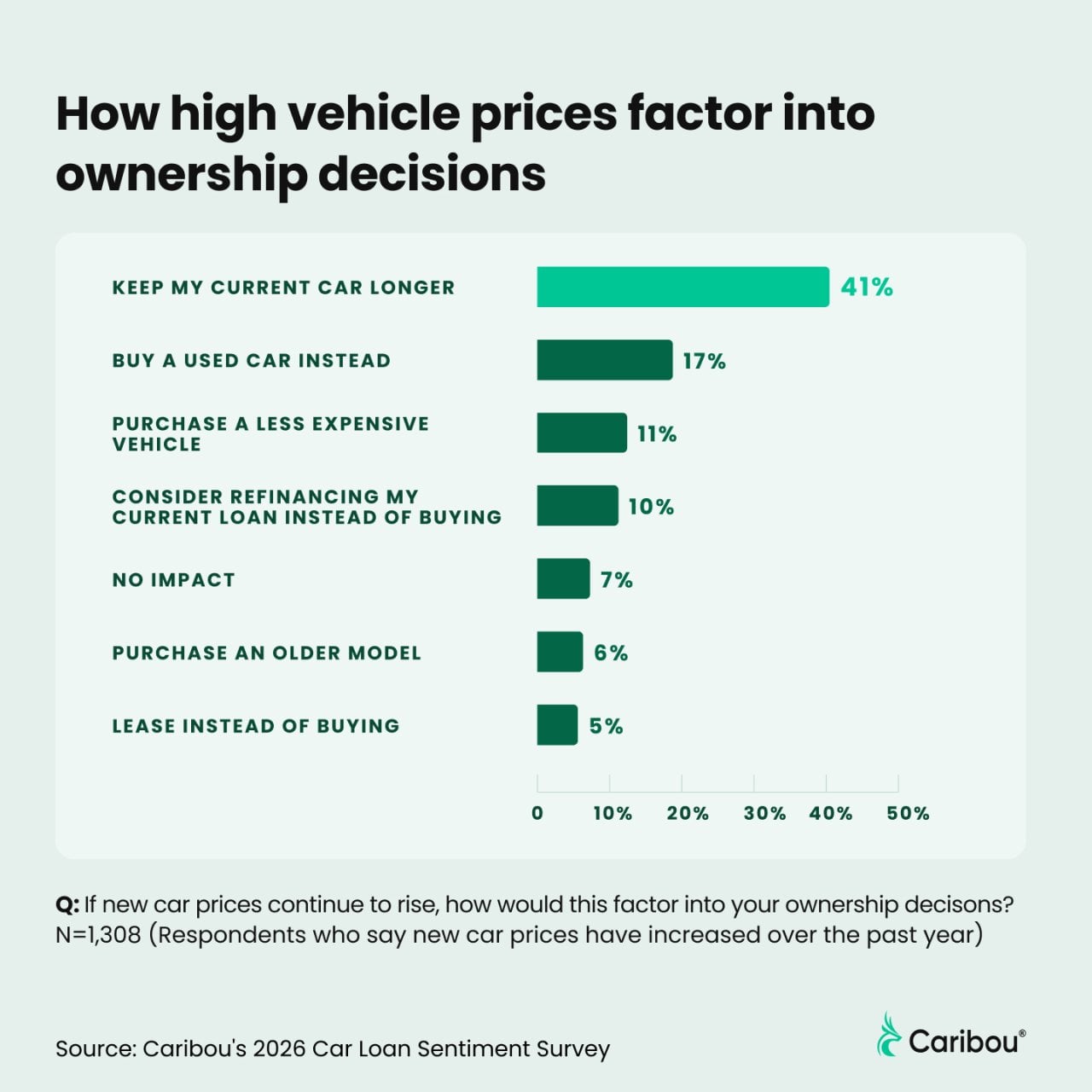
Caribou
This “stay put” decision is reinforced by another factor: Most of these borrowers bought new. Sixty-two percent of survey respondents purchased a new vehicle at their most recent transaction, meaning they’re more likely to keep their car for longer. With new cars averaging $50,000, it’s no surprise why owners see this as a long-term financial commitment.
Older generations are also more likely to hold on to their cars. Among Baby Boomers who noticed vehicle price increases, 58% say they’ll keep their current car longer—the highest response of any generation and nearly double the share of Gen Z. Gen X came in at 49%. These are also the generations most likely to have paid down a meaningful portion of their loan, making their current car an asset worth preserving.
Prime credit borrowers follow a similar pattern. Among those with scores of 800–850, 52% plan to keep their vehicle longer in response to rising prices. They’re also the borrowers most likely to qualify for better loan terms through refinancing.
Keeping a car longer raises the stakes on the original loan
For the growing number of drivers keeping their cars longer, the terms of the loan they took out—possibly in a different rate environment and under pressure at a dealership—become more consequential over time. Most borrowers didn’t accept their original terms under favorable conditions. Forty-four percent of respondents felt moderately to very pressured during the financing process, and about 1 in 4 believe they did not get the best deal.
High car prices have also led more borrowers to take on longer loan terms to keep monthly payments affordable. According to Edmunds, 84-month loans hit an all-time high in Q2 2026, now accounting for nearly 1 in 4 new-car financing agreements. But a longer term means more months of exposure to whatever rate was locked in at signing.
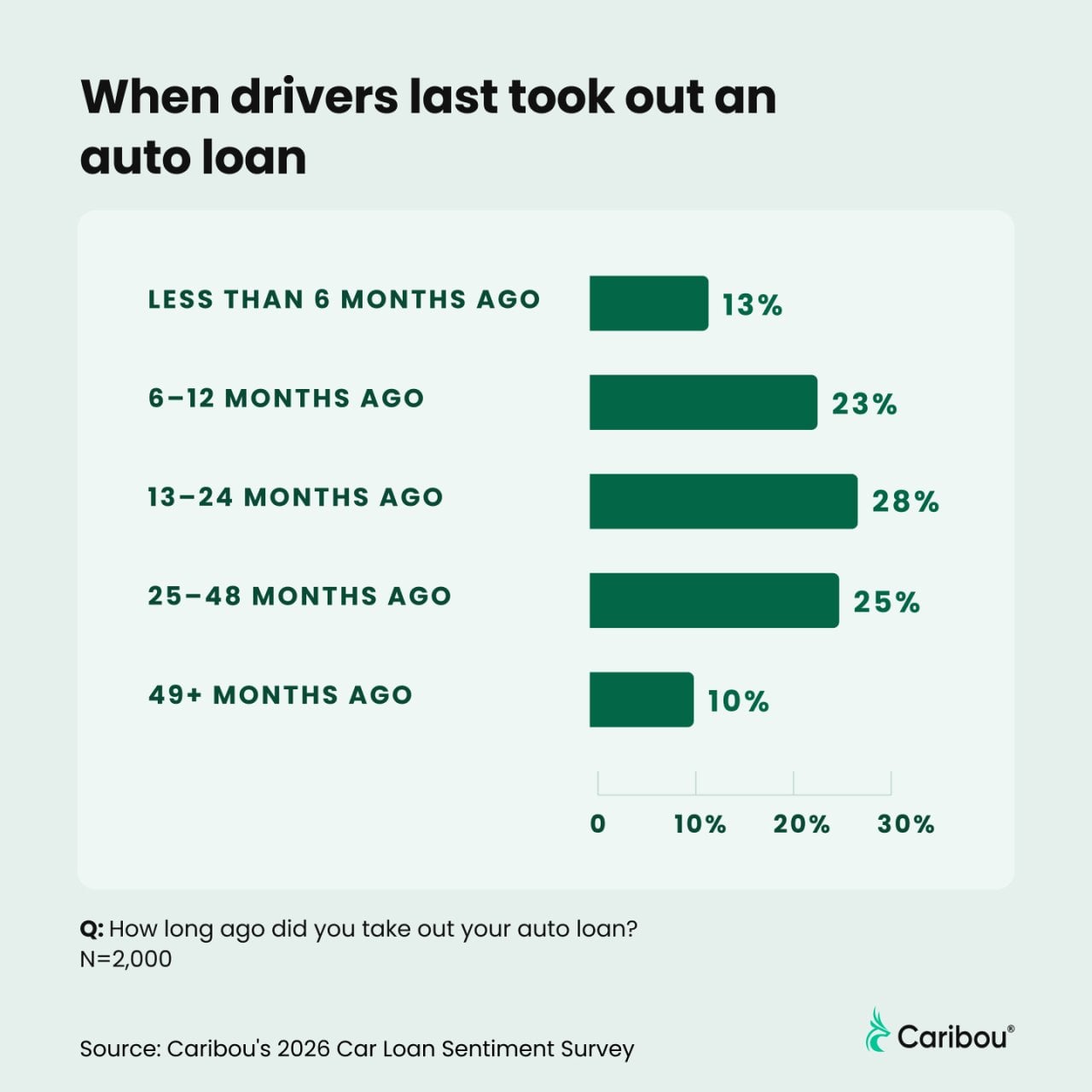
Payment strain raises the stakes even further. Nearly 1 in 3 borrowers struggled to make their car payment on time in the past year. And 23% currently owe more than $30,000 on their loan, meaning they’ll be carrying this balance for years. The question is at what rate. Over half (53%) of borrowers took out their current loan one to four years ago, during a postpandemic, high-rate environment. Auto loan rates climbed sharply in 2022, peaking in early-mid 2024. These same borrowers could see meaningful savings based on today’s rates.
Caribou
As vehicles age, drivers need a stronger safety net
For a borrower already managing a tight car payment, an unplanned engine, transmission, or brake repair is a genuine financial threat. According to a recent Federal Reserve survey, the single most common unexpected expense Americans reported in the past year was a major vehicle repair or replacement—cited by 30% of adults, ahead of both home repairs and medical expenses.
When asked what they’d do saving $150 a month on their car payment, 56% of borrowers said they’d build emergency savings. For someone holding onto a vehicle longer, this buffer is what keeps an unexpected repair bill from derailing their budget. Drivers should also consider other protections designed for extended ownership, such as a vehicle service contract (VSC), which helps cover certain mechanical repairs after the manufacturer’s warranty expires, and guaranteed asset protection (GAP) coverage that can pay the difference if a car is totaled or stolen and the insurance payout is less than the remaining loan balance.
The original deal doesn’t have to be the final one
Car owners may be staying put, but they don’t have to carry their original loan terms all the way through. Yet, only 29% of auto loan holders have ever checked whether they qualify for a lower rate. Among those who have refinanced, 95% succeeded in lowering their payment, their annual percentage rate (APR), or both. The challenge is that most borrowers closed the chapter on their car loan the day they drove off the lot.
But changes in the market suggest that these borrowers are starting to reconsider their original loan terms. More than half (56%) say they’re likely to consider refinancing in the next 12 months—a meaningful signal of intent. For the majority who haven’t checked yet, the window is open, and the longer the car stays in the driveway, the more that window is worth using.
This story was produced by Caribou and reviewed and distributed by Stacker.