Upheal Completes the AI-Native EHR with Insurance Billing, Denial Appeals, and an Agentic Assistant
Specialized agents file claims, appeal denials, prep sessions, and migrate practices, using EHR documentation as

Press Release Disclaimer: This is a press release distributed through the XPR Media network. It has not been independently verified by our newsroom.
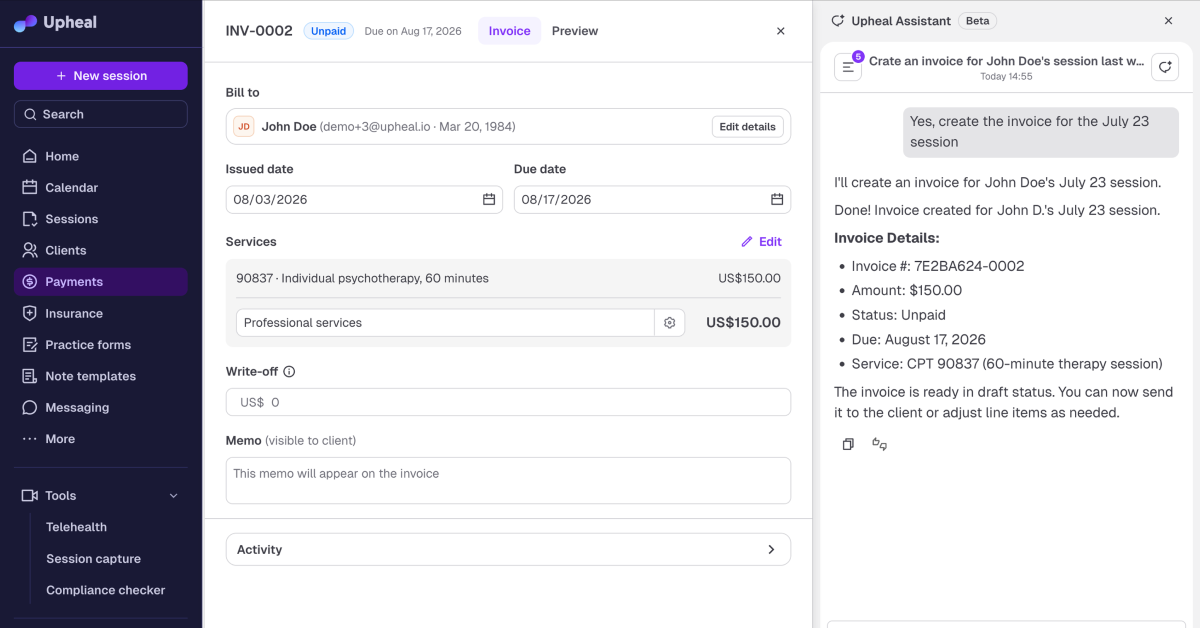

Specialized agents file claims, appeal denials, prep sessions, and migrate practices, using EHR documentation as context and EHR capabilities as rails.
summarizes. AI-native software does the work.”
WASHINGTON, DC, UNITED STATES, August 6, 2026 /EINPresswire.com/ — Upheal, the AI-native EHR for mental health professionals, today announced the general availability of insurance billing with AI-drafted denial appeals, alongside an agentic AI Assistant that can operate the entire platform. The announcement was made at the American Psychological Association’s annual convention in Washington, D.C.
Therapists first came to Upheal for AI session notes. Today’s launch completes the rest of the practice: billing, scheduling, documentation, outcome measurement, and migration from another EHR, all running on one system.
The launch marks a shift in what an electronic health record (EHR) can be. Most EHRs added AI as a feature on top of software designed a decade ago. Upheal was built the other way around, as an agentic platform where AI runs through every workflow, using the practice’s documentation as context and the EHR’s own capabilities as rails. Because the Assistant can read the clinical record and act through the same systems the therapist uses, it doesn’t just write about the work. It does the work, with the clinician in the loop at every step.
That difference runs through every feature. Billing is the newest example. When a payer denies a claim, Upheal decodes the denial reason, and the therapist asks the Assistant to draft the appeal, grounded in the payer’s requirements and their own clinical documentation. Work that used to take hours now takes seconds. The therapist reviews and sends. Eligibility checks, claim creation, and payment reconciliation run the same way: prepared in the background, shown for approval, and never submitted without the clinician’s sign-off. Clinicians bill under their own NPI, with their own payer contracts and their own rates, in deliberate contrast with insurance networks where clinicians bill under the platform’s contracts instead of their own.
Away from billing, the same architecture shows up in places therapists don’t expect. Secure client messages can be drafted from a client’s actual notes, treatment plans, and assessments rather than from a blank box.
Outcome measurement is the clearest clinical example, in a feature Upheal calls Insights. Payers increasingly expect measurement-based care. Assessments like the PHQ-9 and GAD-7 go out to the client portal, come back scored, and are charted over time with clinical severity zones. The AI then interprets each new score in the context of the client’s most recent session, so a clinician sees why a number moved and what it means for this particular client, rather than being handed a score and a trend line to decode alone.
Insights also watches for risk. Any non-zero response to PHQ-9 item nine, the question about thoughts of self-harm, triggers an immediate email to the clinician and a flag on the client’s chart.
Also announced today:
Self-driving migration.
Therapists switching from another EHR drop in an export and the AI rebuilds the practice inside Upheal, recreating clients, notes, history, and details automatically, with the Assistant asking about anything ambiguous. It removes the single biggest reason practitioners stay on software they have outgrown.
An agentic Assistant, not a chat window.
Anything a therapist previously had to do by clicking through the software, Upheal Assistant can now do on request: schedule, bill, document, report, draft and send client messages. It works the whole multi-step task rather than handing back a suggestion, and it brings the therapist in for any decision that matters.
Answers as interface, not text.
The Assistant replies with AI-generated UI: sortable tables, charts, and summaries a therapist can filter, open, and download, rather than paragraphs describing numbers.
Automatic session prep.
Ten minutes before each session, therapists get a summary drawn from the client’s full record, including history, notes, assessment scores, treatment plan, and past transcripts. It flags what matters for the hour ahead, and therapists can ask follow-up questions in the Assistant, with zero setup.
Upheal’s automation is deliberately bounded. For now, nothing acts without the clinician: every draft is shown for review, nothing is sent without sign-off, and therapists who don’t want AI writing their notes can dictate a summary or write from scratch. As agentic workflows mature, clinicians will be able to grant the Assistant more autonomy over administrative work, always by choice.
“Every EHR now has an AI feature. That’s not the same thing as an EHR built on AI,” said Juraj Chrappa, co-founder and CEO of Upheal. “Software with AI bolted on watches you work and summarizes. AI-native software does the work. And because the AI lives inside the record instead of on top of it, it can hold a job: bill like a biller, prep like an assistant, chase a denial like someone whose job that is. That’s why therapists describe Upheal as a team rather than a feature. You cannot build that on top of someone else’s EHR.”
Building on the saved Skills and Assistant memory already available to users, Upheal will preview its agent platform later this year, including pre-built agents for intake, compliance, and money management, and the ability for practices to build their own. A clinician-facing mobile app, bringing the Assistant to therapists on their phone so they can run the practice from anywhere, launches this month.
Upheal is exhibiting at APA 2026 at booth 424 in the Tech Hub, where nearly everything announced today runs live: claims appealed, practices migrated, sessions prepped. Attendees can also run Upheal’s Growth Audit on their own practice, a two-minute check of how findable they are when prospective clients search, including inside AI assistants.
About Upheal
Upheal is the AI-native EHR that does the work. Unlike EHRs that added AI as a bolt-on feature, Upheal runs AI through every workflow, including clinical notes, insurance billing and denial appeals, compliance checks, treatment plans, scheduling, telehealth, and practice migration. It writes the notes, runs billing, and checks compliance, so therapists can focus on therapy. Founded in 2021 and backed by $14M in funding, Upheal is built for solo therapists and small group practices, and is trusted at scale by enterprise behavioral health organizations.
Juraj Chrappa
Upheal
email us here
Visit us on social media:
LinkedIn
Facebook
YouTube
Watch Upheal Insurance Billing: From signed note to paid claim
Legal Disclaimer:
EIN Presswire provides this news content “as is” without warranty of any kind. We do not accept any responsibility or liability
for the accuracy, content, images, videos, licenses, completeness, legality, or reliability of the information contained in this
article. If you have any complaints or copyright issues related to this article, kindly contact the author above.

Media gallery