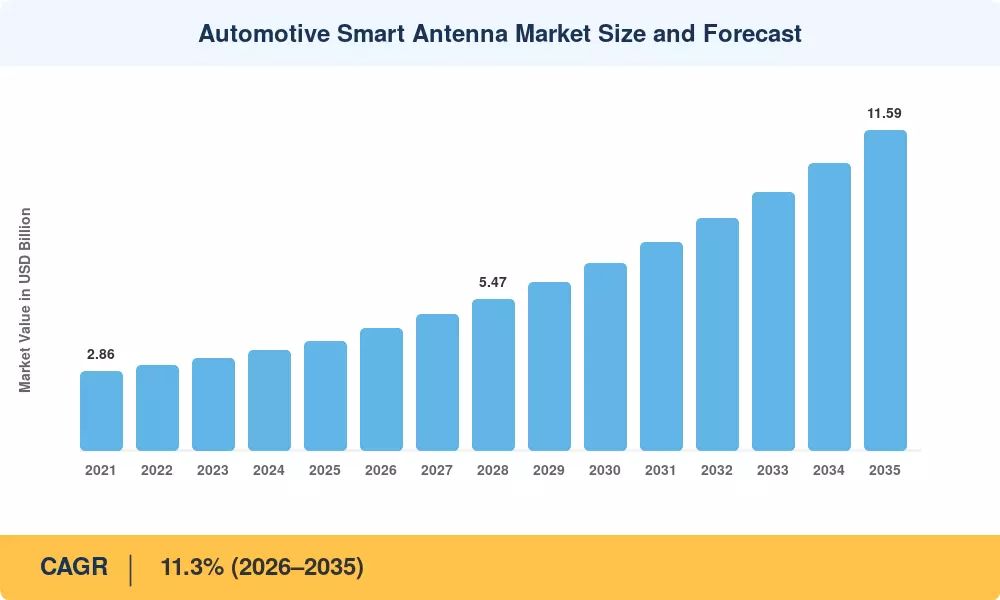
Automotive Smart Antenna Market to Reach USD 11.59 Billion by 2035, Growing at 11.3% CAGR
Passenger cars held a dominant position in the Automotive Smart Antenna Market in 2025, accounting for roughly 70% of

Press Release Disclaimer: This is a press release distributed through the XPR Media network. It has not been independently verified by our newsroom.

Passenger cars held a dominant position in the Automotive Smart Antenna Market in 2025, accounting for roughly 70% of total demand.
NEW YORK, NY, UNITED STATES, August 27, 2026 /EINPresswire.com/ — According to Market Research Future, the Automotive Smart Antenna Market is projected to reach USD 4.42 billion in 2026 before climbing to USD 11.59 billion by 2035, expanding at a CAGR of 11.3% during 2026–2035. This robust growth reflects the rapid evolution of vehicle connectivity, where antennas are transitioning from simple radio receivers to sophisticated, multi-functional communication hubs essential for connected vehicle ecosystems. The convergence of advanced connectivity technologies, including 5G, V2X communication, and high-bandwidth infotainment, is fundamentally redefining the role of antennas within modern vehicles .
Market Overview
Automotive smart antennas represent an evolution from traditional vehicle antennas, integrating multiple communication functions into a single, intelligent module that supports navigation, telematics, infotainment, and advanced driver assistance systems. These systems incorporate transceivers, electronic control units, and sophisticated signal processing capabilities that enable seamless connectivity across various frequency bands and communication protocols. The market encompasses shark-fin designs, fixed mast configurations, glass-integrated solutions, and embedded modules that cater to diverse vehicle architectures.
The key growth drivers propelling this market expansion include the rapid deployment of 5G connectivity and the increasing integration of vehicle-to-everything communication, which demands advanced antenna systems capable of handling higher data speeds and improved network performance . The growing demand for connected vehicles, rising adoption of electric vehicles, and increasing production of premium and mid-segment cars are creating sustained demand for smart antenna solutions . The integration of advanced driver-assistance systems and sophisticated infotainment platforms further reinforces the need for reliable, high-performance antenna systems that can support the data-intensive requirements of modern vehicles .
Technological developments are reshaping the smart antenna landscape at an accelerating pace. The adoption of multiple-input multiple-output technology and beamforming capabilities enables improved signal quality and real-time data connectivity . Automotive manufacturers are increasingly moving toward integrated hardware-software offerings that combine RF modules, antenna arrays, and software to streamline fitment and certification processes . The shift toward software-defined vehicles has elevated antenna strategy from an engineering detail to a cross-functional imperative, as automakers seek differentiated connectivity experiences .
The Connected Vehicle Market is closely intertwined with smart antenna development, as connected vehicles increasingly require communication capabilities that allow interaction with infrastructure, other vehicles, and transportation networks. The growing deployment of connected vehicle platforms and telematics services is creating sustained demand for advanced antenna solutions that can support seamless connectivity across diverse operating conditions.
📍 Get Free Sample Report for Detailed Market Insights:
https://www.marketresearchfuture.com/sample_request/7303
Market Segmentation
The automotive smart antenna market is segmented based on antenna type, frequency band, connectivity technology, vehicle type, vehicle propulsion, and installation location to provide comprehensive insights into the industry landscape.
By Antenna Type: The market is categorized into Shark-Fin, Fixed Mast, Glass/Integrated, Embedded Module, and Others. Shark-fin antennas represent a dominant segment, offering aerodynamic styling combined with multi-band communication capabilities. These designs are increasingly preferred for their aesthetic integration with modern vehicle styling. Glass and integrated antennas are gaining traction as manufacturers seek to embed antennas within vehicle body panels to maintain exterior styling while ensuring optimal signal performance. Embedded modules offer flexibility for aftermarket applications and specific vehicle architectures.
By Frequency Band: The market covers Very High Frequency (VHF), Ultra High Frequency (UHF), Super High Frequency (SHF/mmWave), and High Frequency (HF). Super High Frequency and mmWave bands are growing in importance with the expansion of 5G connectivity, enabling higher data throughput and low-latency communication for infotainment and telematics applications. Ultra High Frequency bands continue to support conventional communication and navigation systems, while Very High Frequency bands serve specific regulatory and emergency applications.
By Connectivity Technology: The market is segmented into 3G/4G/LTE, 5G NR, Wi-Fi/Bluetooth, and DSRC/C-V2X. The 5G NR segment is growing rapidly, driven by the increasing deployment of 5G connectivity in vehicles and the need for high-bandwidth applications such as real-time infotainment, over-the-air updates, and autonomous driving support . Dedicated Short-Range Communications (DSRC) and Cellular Vehicle-to-Everything (C-V2X) are gaining traction as vehicle-to-everything communication becomes a focus area across the industry, enabling vehicles to interact with infrastructure, other vehicles, and transportation networks .
By Vehicle Type: The market serves Passenger Cars, Light Commercial Vehicles, and Heavy Commercial Vehicles. Passenger cars dominate the segment, driven by high production volumes, consumer demand for connectivity features, and increasing integration of infotainment and safety systems. Commercial vehicles represent a growing segment as telematics, fleet management, and vehicle tracking applications require reliable connectivity solutions.
By Vehicle Propulsion: The market covers ICE vehicles, Battery Electric Vehicles, Plug-in Hybrid Electric Vehicles, and Fuel Cell Electric Vehicles. Electric vehicles are emerging as a significant growth area, as they often require advanced communication systems to support navigation, charging services, fleet management, and connected vehicle functions . The expansion of electric vehicle production is contributing to strong market expansion across major automotive regions.
By Installation Location: The market is categorized into Roof, Windshield/Glass, Bumper/Fascia, and Interior/Dashboard. Roof-mounted antennas, particularly shark-fin designs, remain the most common installation location, offering optimal signal reception and aesthetic integration. Windshield and glass-integrated antennas are gaining popularity as they offer discreet placement while maintaining communication performance. Bumper and fascia installations are emerging for specific applications, particularly for sensors and short-range communication systems.
By Region: The market analysis covers North America, Europe, South America, Asia Pacific, and the Middle East and Africa, providing comprehensive geographic insights into regional dynamics and growth opportunities.
🛒 You can buy this market report at:
https://www.marketresearchfuture.com/checkout?currency=one_user-USD&report_id=7303
Regional Analysis
Asia Pacific represents a significant and fastest-growing regional market, driven by the region being the largest automotive manufacturing hub and the rapid adoption of connectivity features across vehicle segments. China leads the region with aggressive government initiatives promoting new energy vehicles and intelligent connected vehicles, creating strong demand for advanced antenna solutions. Japan and South Korea are advancing automotive electronics through significant OEM investments and technology development programs, contributing to regional market growth. India is gaining traction through expanding commercial vehicle production, growing EV adoption, and increasing demand for connected vehicle features. Regional supply chains provide deep component ecosystems that accelerate prototyping and cost optimization, while local OEMs push for integrated solutions that support high-volume production and feature-rich connectivity stacks .
Europe represents a mature and rapidly evolving market, shaped by ambitious connectivity initiatives, stringent safety regulations, and strong OEM leadership in automotive technology. Germany, France, and the United Kingdom are leading the region, with significant investments in connected vehicle infrastructure, 5G deployment, and technology demonstration programs. The European Union’s commitment to digitalization and sustainable mobility continues to create a favorable environment for smart antenna adoption, while the region’s strong automotive heritage drives innovation in integrated vehicle electronics.
North America represents a key market for automotive smart antennas, driven by strong consumer demand for connectivity features, government incentives for electric vehicles, and corporate sustainability commitments. The United States leads the region with substantial investments in advanced connectivity solutions and autonomous driving technologies. The growing adoption of 5G networks and vehicle-to-everything communication is creating demand for sophisticated antenna solutions capable of handling increased data throughput and improved network performance.
South America and the Middle East and Africa represent emerging markets with growing potential. Brazil and Mexico are spearheading early adoption, driven by expanding commercial vehicle production, improving economic conditions, and growing connectivity demand. The Middle East, particularly the UAE and Saudi Arabia, is showing increasing interest in connected mobility solutions as part of smart city initiatives, while African markets are at varying stages of development with South Africa leading the region .
Competitive Landscape and Key Players
The automotive smart antenna market is highly competitive, featuring a mix of established automotive suppliers, technology specialists, and emerging innovators. The competitive landscape is characterized by technological innovation, strategic partnerships, and integrated hardware-software offerings.
Key players operating in this market include HARMAN International, Panasonic Corporation, Continental AG, Robert Bosch GmbH, DENSO Corporation, Aptiv PLC, TE Connectivity Ltd, Hella GmbH & Co. KGaA, Ficosa Internacional SA, Kathrein Automotive GmbH, and Laird Connectivity . These industry leaders are investing heavily in research and development to create advanced smart antenna solutions that support multiple frequency bands, connectivity technologies, and vehicle platforms.
Strategic developments are reshaping the competitive landscape. Leading suppliers are demonstrating strengths in cross-domain engineering, offering integrated RF modules, antenna arrays, and software that streamline fitment and certification . Partnerships between tier suppliers and OEMs increasingly center on co-development agreements, wherein component firms commit engineering resources to jointly validate antenna performance within vehicle platforms, reducing time-to-integration and aligning product roadmaps with OEM feature cycles .
Innovation and technology initiatives are accelerating across the industry. Companies are developing modular antenna platforms that support multi-band operation and simplified mechanical interfaces to reduce vehicle-specific rework . Firms are establishing repeatable design kits, reference architectures, and digital twin capabilities that enable faster customization for different vehicle programs . The integration of software-driven differentiation, including calibration routines, adaptive beamforming, and over-the-air update mechanisms, is extending lifecycle value and creating competitive advantage.
Latest Industry News and Developments
Recent industry developments highlight the dynamic nature of the automotive smart antenna market. Major automotive electronics suppliers continue to expand their connectivity portfolios through new product launches and strategic partnerships. Companies are investing in modular antenna platforms that support multi-band operation and simplified mechanical interfaces to accelerate integration across different vehicle architectures.
The growing adoption of 5G connectivity in vehicles has prompted major suppliers to develop integrated antenna modules that support high-speed data transmission, low-latency communication, and enhanced network performance. These developments are enabling automakers to offer sophisticated connected vehicle experiences, including real-time infotainment, over-the-air updates, and advanced telematics services.
Technology demonstration projects continue to advance smart antenna capabilities. Leading suppliers are establishing robust co-development frameworks with OEMs and tier partners that formalize data exchange, validation criteria, and joint roadmaps, including shared simulation models, over-the-air testbeds, and synchronized release cycles . These collaborative models are reducing integration friction and enabling faster time-to-market for advanced connectivity solutions.
Market Challenges and Opportunities
The automotive smart antenna market faces several key challenges that could impact growth trajectories. The complexity of integrating multiple communication technologies into a single vehicle platform requires substantial investment in engineering and validation resources. Interoperability concerns across different connectivity standards and regulatory regimes can create deployment challenges, particularly for global vehicle platforms. Supply chain vulnerabilities and component availability can impact production timelines and costs, while cybersecurity concerns associated with connected vehicle systems require robust protection measures.
Emerging opportunities are abundant in the evolving mobility landscape. The growing deployment of 5G networks and vehicle-to-everything communication creates enormous potential for advanced smart antenna solutions capable of handling higher data throughput and improved network performance. The shift toward software-defined vehicles offers opportunities for smart antenna providers to deliver differentiated connectivity experiences through software enhancements and over-the-air updates. The integration of smart antennas with autonomous driving systems, telematics platforms, and connected vehicle ecosystems creates comprehensive solutions that serve diverse customer needs.
Technology-driven possibilities are expanding rapidly with advancements in millimeter-wave communication, artificial intelligence, and adaptive beamforming. AI-powered signal processing and optimization capabilities enhance antenna performance across diverse operating conditions, while smart antenna technologies integrated with vehicle control systems enable advanced driver assistance and autonomous driving applications.
Future growth potential remains strong, driven by the accelerating transition to connected, autonomous, and electric mobility. As vehicles become increasingly connected and software-defined, the role of smart antennas will continue to expand, ensuring sustained relevance and growth throughout the forecast period.
To explore more market insights, visit us at:
https://www.marketresearchfuture.com/reports/automotive-smart-antenna-market-7303
Final Market Summary
The automotive smart antenna market is positioned for substantial growth, driven by technological advancement, regulatory support, and the accelerating transition to connected mobility. The market’s trajectory from USD 4.42 billion in 2026 to USD 11.59 billion by 2035 reflects the critical importance of advanced antenna systems in enabling the connected vehicle ecosystem.
The long-term industry potential remains remarkably strong, with advancements in 5G connectivity, vehicle-to-everything communication, and smart antenna technologies continuing to expand the addressable market. The convergence of smart antennas with broader mobility ecosystems, including autonomous driving, telematics, and electric vehicle platforms, is creating comprehensive solutions that serve diverse customer needs across vehicle segments and geographic regions.
Key factors expected to influence future development include the pace of 5G network deployment, advancements in communication technologies, and the evolution of connected vehicle platforms. The development of universal interoperability standards will address compatibility concerns and accelerate market growth. Investments in smart antenna platforms that support multi-band operation, software-driven differentiation, and scalable integration will enable manufacturers to meet the evolving demands of connected and automated vehicles.
The transformation from simple radio receivers to sophisticated, multi-functional communication hubs represents a fundamental industry evolution, positioning automotive smart antennas as essential components of the connected vehicle ecosystem. As vehicles become increasingly connected, autonomous, and software-defined, the role of smart antennas will continue to expand, ensuring sustained innovation and growth throughout the forecast period and beyond.
More Related Reports from MRFR Library:
Hybrid Drivetrain Market : https://www.marketresearchfuture.com/reports/hybrid-drivetrain-market-32895
In Car Gaming Market : https://www.marketresearchfuture.com/reports/in-car-gaming-market-32950
In Taxi Digital Signage Market : https://www.marketresearchfuture.com/reports/in-taxi-digital-signage-market-32965
Intercity Buses Market : https://www.marketresearchfuture.com/reports/intercity-buses-market-33122
Motorcycle Airbag Market : https://www.marketresearchfuture.com/reports/motorcycle-airbag-market-33296
Electric Scooter Lift and Carrier Market : https://www.marketresearchfuture.com/reports/electric-scooter-lift-carrier-market-33504
Automotive ADAS and Park Assist Market : https://www.marketresearchfuture.com/reports/automotive-adas-park-assist-market-34128
Automotive Control Arm Market : https://www.marketresearchfuture.com/reports/automotive-control-arm-market-34137
Automotive Part Aftermarket Market : https://www.marketresearchfuture.com/reports/automotive-part-aftermarket-market-34459
Automotive Steering Column Market : https://www.marketresearchfuture.com/reports/automotive-steering-column-market-34461
Market Research Future
Market Research Future
+1 855-661-4441
email us here
Legal Disclaimer:
EIN Presswire provides this news content “as is” without warranty of any kind. We do not accept any responsibility or liability
for the accuracy, content, images, videos, licenses, completeness, legality, or reliability of the information contained in this
article. If you have any complaints or copyright issues related to this article, kindly contact the author above.

Media gallery