Federal Deadlines and Building-Performance Mandates Are Changing How Commercial Property Owners Approach Solar
New market update from Solect Energy outlines what property owners need to know about project timing, compliance

Press Release Disclaimer: This is a press release distributed through the XPR Media network. It has not been independently verified by our newsroom.


Solect Energy, a leading commercial and public-sector solar and energy storage developer serving the Northeast, released a new market update examining how federal tax-credit deadlines, expanding building-performance requirements, and rising electricity costs are reshaping how commercial real estate owners evaluate and structure solar projects.
This press release features multimedia. View the full release here: https://www.businesswire.com/news/home/20260806550242/en/
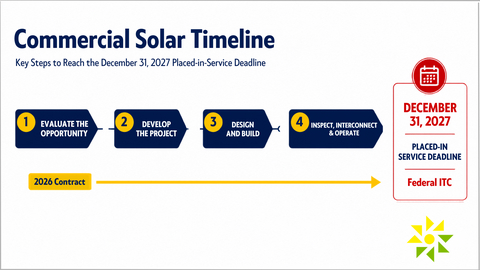
Commercial Solar Timeline with the key steps to reach the December 31, 2027, placed-in-service deadline for federal investment tax credit
Under current federal law, solar projects that begin construction now must be placed in service by December 31, 2027, to remain eligible for the federal investment tax credit — a timeline that remains workable for contracts in 2026, but leaves little room for delays to complete development, installation and commissioning new project purchases. At the same time, building-performance ordinances such as Boston’s BERDO and Cambridge’s BEUDO require non-compliance payments for commercial properties that do not conform. Under BERDO, building owners may make Alternative Compliance Payments of $234 for every metric ton of CO₂e above a building’s emissions limit. Owners that remain out of compliance may also face penalties of $1,000 per day for larger covered buildings. In 2024 Massachusetts implemented Large Building Energy Reporting requirement for every building over 20,000 square feet.
“Commercial property owners are navigating the convergence of federal incentive deadlines and state and local building-performance policies, and it’s affecting our customers in Massachusetts, Rhode Island and New York,” said Matt Shortsleeve, SVP of Policy & Marketing at Solect Energy. “Owners are evaluating properties for new solar installations now to capture 30% or 40% of project costs before federal tax credits expire. These planning meetings provide our customers clarity and more flexibility to planfully align solar investments with compliance strategies, capital plans, and long-term energy cost containment strategies across the portfolio.”
In preparation for the ITC safe-harbor deadline, Solect invested in more than 100 MW of solar equipment to support future projects. Because Solect can finance and own site-lease and power-purchase-agreement projects, deploying ITC-eligible equipment flows through to more competitive site lease payments and energy pricing. The analysis highlights Solect’s work with Parsons Commercial Group, where 22 completed projects are split nearly evenly between direct ownership and Solect-financed site leases — an example highlighting winning financing structures applied property by property within a single portfolio.
Read “The Changing Economics of Solar for Commercial Real Estate,” which covers the federal incentive timeline, compliance cost exposure under building-performance ordinances, ownership and financing structures, and how to evaluate a solar partner capable of executing within the current deadlines.
About Solect Energy
Founded in 2009 and headquartered in Hopkinton, MA, Solect Energy is a nonresidential solar and energy storage developer, investor, installer and energy services provider serving the Northeast. A Pattern Energy company, Solect provides comprehensive services spanning design, development, installation, financing, and asset and fleet management, including operations and maintenance.
For more information, visit www.solect.com
View source version on businesswire.com: https://www.businesswire.com/news/home/20260806550242/en/
Media gallery