Rubedo Life Sciences Announces Clinical Study to Treat Hair Loss with GPX4 Modulator RLS-1496, First Human Ex Vivo Evidence Demonstrates Robust Hair Follicle Growth
AGA clinical trial to begin in Fall 2026 led by David Pariser, MD, FACP, FAAD, former President of the American Academy

Press Release Disclaimer: This is a press release distributed through the XPR Media network. It has not been independently verified by our newsroom.


Rubedo Life Sciences, Inc. (Rubedo) today announced a new clinical study of investigational RLS-1496 in patients with androgenetic alopecia (AGA), beginning October 2026, with initial data expected in the first half of 2027. The study marks the first-ever clinical evaluation of a GPX4 modulator in hair loss, extending the program that established RLS-1496 as the world’s first GPX4 modulator to enter human clinical trials of any kind.
This press release features multimedia. View the full release here: https://www.businesswire.com/news/home/20260916811892/en/
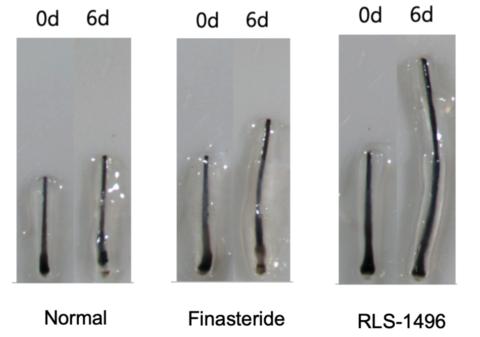
Figure Legend:
Representative images of intact ex vivo human hair follicles challenged with DHT 100 nM and stimulated with finasteride 600 nM (positive control) or RLS-1496 2000 nM at Days 0 and 6.
RLS-1496 has already demonstrated efficacy in clinical trials for actinic keratoses and aging skin, and other skin conditions such as psoriasis and atopic dermatitis, generating novel human evidence demonstrating the dual SenoAdaptive mechanism that clears pathologic senescent cells and promotes a redox reset by modulating NRF2 pathways in stressed aged cells, including stem and progenitor cells. Ex vivo studies on a human hair follicles AGA model resulted in the restoration of hair follicle growth, as depicted in the image above.
In an independent ex vivo human AGA model — conducted using intact human hair follicles from male patients with AGA, challenged with dihydrotestosterone (DHT) to replicate the follicular miniaturization environment seen in AGA patients — RLS‑1496 demonstrated statistically and highly statistically significant increases in hair follicle elongation compared to vehicle control at 2 doses, respectively, with the highest dose showing a numerically greater trend in mean elongation than finasteride.
- Hair follicle elongation at Day 6 was greater with RLS-1496 versus vehicle across all doses, with the strongest effect at the highest concentration — directionally outperforming standard-of-care finasteride
- The pattern is consistent with rescue of the anagen (active growth) phase, when targeting senescent cells from the follicular niche allows stem cell reactivation from the dormant state and the follicle to resume its natural growth program
“The senescent cell biology underlying hair follicle aging is compelling, deeply consistent with what we have seen across our RLS-1496 program, and vastly underexplored as a therapeutic target,” said Rubedo Chief Executive Officer Frederick Beddingfield III, MD, PhD, FAAD. “For the first time, we are bringing a medicine into the clinic designed to clear the aged cells at the root of stem cell dormancy and follicular miniaturization. We are proud to do so in partnership with Dr. Pariser, and we are moving with the same urgency that made RLS-1496 the world’s first GPX4 modulator in human trials.”
AGA is the most prevalent form of hair loss globally, affecting approximately 50 million men and 30 million women in the U.S. alone; however, the treatment landscape has seen no genuinely new FDA-approved approaches in nearly 30 years.2 The global AGA market, valued at $3.2 billion in 2025 and projected to reach $6.8 billion by 2035, is defined by two therapies — minoxidil and finasteride — that slow the hormonal signals that cause hair follicles to progressively shrink and degenerate, a process known as follicular miniaturization. Follicular miniaturization is the biological hallmark of AGA, in which each successive growth cycle produces a thinner, shorter hair until the follicle can no longer produce visible hair. Neither therapy addresses the senescent — aged and dysfunctional — cells now understood to accumulate within the follicular niche and drive this miniaturization at the cellular level.3,4,5
Unlike existing therapies that target secondary hormonal causes of hair loss, RLS-1496 is designed to act on the primary cellular aging mechanism: the accumulation of senescent and stressed dermal papilla cells that actively suppress stem cells, follicular regeneration, and drive progressive miniaturization. By targeting these cells with selective elimination or functional restoration, depending on the cell state, RLS-1496, a first-in-class SenoAdaptive Drug, aims to remove the cellular brake on follicular regeneration itself.3,4,5,6
Rubedo Co-Founder and Chief Scientific Officer Marco Quarta, PhD, will present the ex vivo data, along with additional RLS-1496 data, at the 13th Annual Aging Research & Drug Discovery (ARDD) Meeting at Harvard University, October 1–3, 2026 — the world’s largest dedicated longevity science conference. The presentation marks the first time a GPX4 modulator program in hair loss will be presented at a major longevity science conference.
Dr. Quarta said, “RLS-1496 appears to act at several convergent points in the AGA disease cascade — where we believe it acts by clearing senescent cells, suppressing follicular regeneration, reducing inflammatory SASP signaling, while also modulating NRF2 pathways and activating Wnt/β-catenin pathways governing anagen re-entry. To our knowledge, no approved AGA therapy operates at this level of biology.”
Rubedo’s proprietary ALEMBIC™ spatial transcriptomics applied to patient hair follicle biopsies identified senescence markers and transcriptomic signals consistent with activation of the follicular regenerative cascade, including the expansion of hair follicle progenitors, and downregulation of key drivers of the follicle regression phase — providing human clinical evidence that RLS-1496’s effects on senescent cell biology extend to hair follicle tissue. In preclinical animal studies, RLS-1496 also achieved approximately 32% greater hair regrowth versus vehicle.1,6,7
“The preliminary data we have seen with RLS-1496 are scientifically intriguing and warranted clinical evaluation,” said Dr. Pariser, Professor of Dermatology at Eastern Virginia Medical School and Principal Investigator of Virginia Clinical Research, Inc., who will be leading the RLS-1496 hair loss clinical trial. “The senescence biology underlying AGA is increasingly well-supported in the published literature, and RLS-1496 represents a genuinely novel approach to it. I look forward to seeing what the data show in patients given the ongoing unmet need.”
About RLS-1496 and GPX4 Modulation
Rubedo’s lead candidate RLS-1496, being developed for topical and oral administration, is a first-in-class, disease-modifying GPX4 modulator selectively targeting pathologic senescent and other stressed, aging cells that drive chronic, age-dependent diseases. These include immunology and inflammation (I&I), dermatology and skin aging, hair loss, metabolic syndrome (obesity, diabetes, liver fibrosis), sarcopenia, and neurodegenerative disease.
In certain pathologic cells, aging is associated with an imbalance in GPX4. Modulation of GPX4 sensitizes cells to ferroptosis, which is a type of programmed cell death and is believed to be an Achilles heel of senescent cells. By modulating GPX4 in ferroptosis-sensitive senescent “aged” cells, RLS-1496 may be able to clear these cells to fight disease and also support healthy cells to function properly and restore tissue homeostasis. Beyond its targeted senolytic function in triggering selective ferroptosis within pathological senescent cells, RLS-1496 can also act as a restorative modulator that induces a vital ‘redox-reset’ through a controlled hormetic response in stressed neighboring cells, effectively clearing the source of chronic inflammation while actively re-establishing healthy tissue homeostasis. This dual-action mechanism represents a novel drug category—Adaptive SenoTherapeutics.
RLS-1496 uses Rubedo’s proprietary, AI-driven drug discovery platform ALEMBIC™, which identifies targets within pathologic senescent cells and develops selective cellular rejuvenation medicines for these targets.
About Rubedo Life Sciences
Rubedo Life Sciences is a clinical-stage biotech developing a broad portfolio of innovative selective cellular rejuvenation medicines targeting aging cells that drive chronic age-related diseases. Our proprietary AI-driven ALEMBIC™ drug discovery platform is developing novel first-in-class small molecules to selectively target pathologic and senescent cells, which play a key role in the progression of pulmonary, dermatological, oncological, neurodegenerative, fibrotic, and other chronic disorders, including hair loss. Our lead drug candidate – RLS-1496, a potential first-in-class disease-modifying GPX4 modulator – is currently in Phase I clinical trials. The Rubedo leadership team is composed of industry leaders and early pioneers in chemistry, AI technology, longevity science, and life sciences, with expertise in drug development and commercialization from both large pharmaceutical and leading biotechnology companies. The company is headquartered in Mountain View, CA, USA, and has offices in Milan, Italy. For additional information, visit www.rubedolife.com.
References
- Rubedo Life Sciences. RLS-1496 demonstrates hair follicle elongation in a DHT-challenged ex vivo androgenetic alopecia model. Data on file. 2026.
- Global Market Insights. Androgenetic Alopecia Treatment Market Size, Share & Trends Analysis Report. 2026
- Bahta AW, Farjo N, Farjo B, Philpott MP. Premature Senescence of Balding Dermal Papilla Cells In Vitro Is Associated with p16(INK4a) Expression. Journal of Investigative Dermatology2008;128(5):1088-1094. doi: 10.1038/sj.jid.5701147
- Yang YC, Fu HC, Wu CY, Wei KT, Huang KE, Kang HY. Androgen Receptor Accelerates Premature Senescence of Human Dermal Papilla Cells in Association with DNA Damage. PLoS ONE2013;8(11): e79434. doi: 10.1371/journal.pone.0079434
- Upton JH, Hannen RF, Bahta AW, Farjo N, Farjo B, Philpott MP. Oxidative Stress-Associated Senescence in Dermal Papilla Cells of Men with Androgenetic Alopecia. Journal of Investigative Dermatology 2015;135(5):1244-1252. doi: 10.1038/jid.2015.28
- Pappalardo A, Kim JY, Abaci HE, Christiano AM. Restoration of hair follicle inductive properties by depletion of senescent cells. Aging Cell2024;24: e14353. doi: 10.1111/acel.14353
- Rubedo Life Sciences. RLS-1496 achieves 32% greater hair regrowth versus vehicle in preclinical animal studies. Data on file. 2026.
View source version on businesswire.com: https://www.businesswire.com/news/home/20260916811892/en/
Media gallery